









From The Daily Nebraskan
By Samuel Whittaker
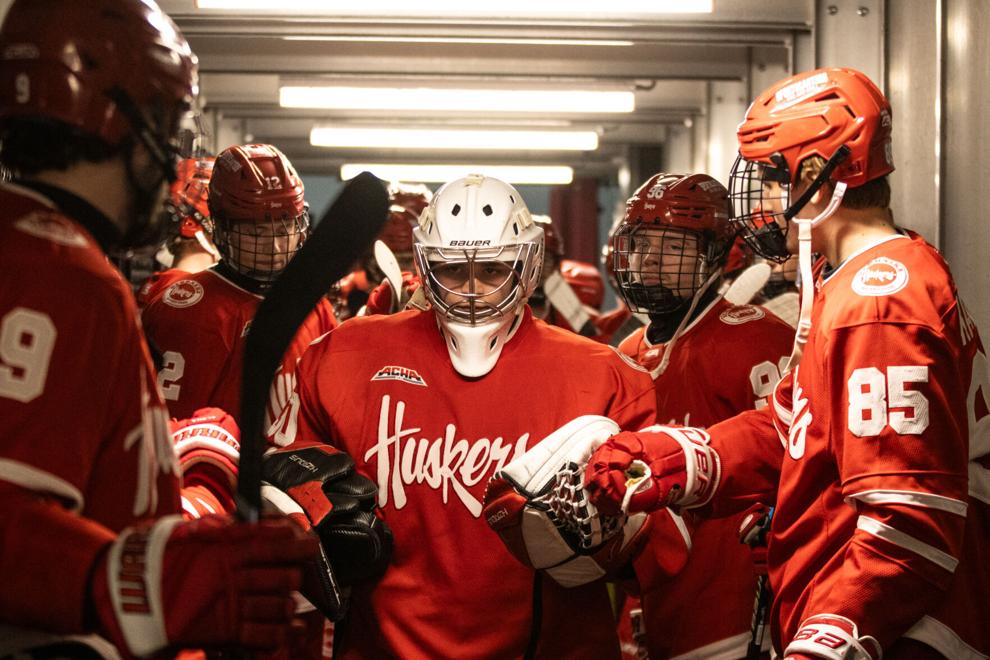
The growth of hockey in Nebraska is now stretching beyond one locker room. What began as a single club operation has expanded into a multi-team program, drawing players from hockey hotbeds like Minnesota and Canada, and has created enough interest that roster spots have become increasingly competitive.
At NU, there are three club hockey teams competing in the American Collegiate Hockey Association (ACHA). This includes two men’s teams competing in Division II and Division III, with the lone women’s squad in Division II, all of which play their home games at John Breslow Ice Hockey Center. While the structure has grown in recent years, it also reflects how much the program itself has expanded.
“When I came in, it kind of felt more like a men’s league five years ago,” senior captain Nate Weber said. “Five years later, although it’s still just for fun, it feels so much more serious. Seeing how the ACHA has grown into more of a legitimate hockey league.”
The biggest shift for the program came following the COVID-19 pandemic. At the time, there was only one men’s team in DIII and the women’s team. Players from the men’s side who didn’t get a chance to play didn’t lose any eligibility, while they also brought in new faces to the team. The natural growth of total players and skill continued to build, leading to the club reaching nationals for the fourth time in five years in 2022, bringing even more attention to the program.
“My first year as head coach, we essentially had a redshirt program,” DII head coach Reed Fuller said. “We had close to 50 guys for one team, so there were 20-some guys who didn’t get ice time. They practiced once a week and stuck with the program, and past coaches like Larry (Taylor) and the other guys never had to deal with, ‘What do you do with 50 hockey players on one team?’”
The solution came via a press release on social media on April 29, 2024, where Husker Hockey announced the addition of a DII program for the 2024-25 season. Fuller noted the staff first noticed the growth would be sustainable four to five years ago.
The first season of the DII program looked much different from what it does now. In its inaugural year, the rosters were effectively flipped, with many of the program’s top players competing on the DIII side. At the same time, the new D II squad built its foundation, giving Husker Hockey its best chance at another national tournament run.
That setup quickly produced results. During the 2024-25 season, both sides saw more consistent attendance on Friday nights, and the DIII team captured the inaugural Nebraska Cup – a regular-season competition among Nebraska, Omaha and Creighton. They also set a program attendance record of 1,277 fans at the Ice Box.
“It used to always be, ‘Oh, we have a hockey team, I didn’t know that,’ to now where you can see that people recognize our team,” Weber said. “I’m very glad I was able to be a part of it, especially coming from a hockey state (Illinois), and seeing how big it can be. I’ve been trying to bring that passion to a state that doesn’t have as much familiarity with it.”
Despite the growth, the club still faces many challenges. In Lincoln, there are only two sheets of ice available to split between the three club teams. The only year-round sheet is at John Breslow Ice Hockey Center, while the Ice Box gets its primary use by the United States Hockey League’s Lincoln Stars. Add in the large quantity of youth programs, figure and public skating, the ice availability during the winter becomes scarce.
“Every offseason, it’s the same things of time, money and resources,” Fuller said. “We don’t have enough time and money to travel and go and watch every single player that’s interested. We don’t have a full-time scout and the last thing I want is to have somebody commit to us from out of state and have them not be a fit. I would love to have three or four practices for each team every week, but we have to split four practices and it makes the commodity of ice time extremely difficult to balance.”
Even with limitations, Nebraska continues to attract players from local programs, out of state and even players from the Triple-A level. Fuller said the program now builds its roster through a mix of local recruiting and players finding Husker Hockey on their own, creating a pipeline that stretches far beyond Nebraska.
Freshman defenseman and Minnesota native Max Grohmann had a connection to Nebraska before arriving in Lincoln, as his mom is an alum. For Grohmann, who grew up where hockey is a major part of the culture, it was the environment around the program that ultimately sold him on coming to NU.
“Nebraska has been in my family for a while,” Grohmann said. “When I came here, actually meeting the guys on the team, it influenced my decision a lot. I saw they enjoyed it, everyone was super close and it was basically just a big family. I knew I wanted to be around these guys that care so much about each other and it wasn’t just strictly about hockey.”
For Fuller, players like Grohmann are a sign of how far the program’s reach has expanded. What was once built largely through local recruiting now attracts players from hockey-heavy states and Canada. This is a change, Fuller said, that speaks not only to the growth of Husker Hockey, but also to the appeal of the university as a whole.
“By definition, we’re club hockey, but there’s nothing club about it,” Fuller said. “We hold our guys and ourselves as a program to a high standard because we want to do things the right way and take care of people. Every night, we’re going against former DivisionI transfers, guys from the Ontario and Western Hockey League, USHL, any league and we treat our guys no differently than a student athlete. You can’t name a better place to get an education and be an athlete than Nebraska.”
While much of the recent growth has come on the men’s side, the women’s program has also continued to grow and establish its place within the club structure. As interest in hockey across campus has increased, the women’s team has steadily built momentum of its own as part of the program’s overall expansion at Nebraska.
For Weber, growth has been something he’s watched unfold from inside the locker room. From the way the program is viewed on campus to how players now approach each season, he said the shift has been noticeable over his time at Nebraska and something that points toward where Husker Hockey is headed far down the line.
“It could be 25 years from now, but I eventually do truly see us becoming an NCAA DI team,” Weber said. “Hockey is a sport that is growing exponentially around the world, not just the ACHA, but hockey in general. I totally see the game in general just growing along with college sports. I think in the Big Ten, hockey is the most underrepresented sport because there’s only seven of the eighteen schools with teams and I think that’s the next sport to really get funding and grow.”
The growth of hockey in Nebraska has been shaped by Husker Hockey, turning what was once a small-scale club program into a multi-team operation with increasing competition, visibility and demand.
As it continues to expand, the program now sits in a place where the identity is no longer about building something new, but managing how far it can still grow, especially with a schedule next season set to face four of the top five teams in the Central Region before Thanksgiving.
(Originally published at https://www.dailynebraskan.com/sports/nothing-club-about-it-nebraska-hockey-s-rapid-expansion-and-future/article_1a59f39e-eac6-401a-8bd4-d87094964334.html)
